


 Cart
Cart
 sales@molnova.com



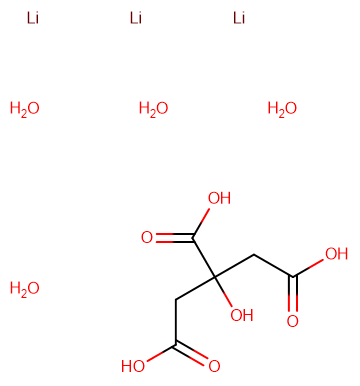
Lithium citrate tribasic tetrahydrate
CAS No. 6080-58-6
Lithium citrate tribasic tetrahydrate( —— )
Catalog No. M15283 CAS No. 6080-58-6
Lithium Citrate is the active component of Lithium which is a drug used in treatment of psychiatric disease.
Purity : >98% (HPLC)
 COA
Datasheet
HNMR
HPLC
MSDS
Handing Instructions
COA
Datasheet
HNMR
HPLC
MSDS
Handing Instructions
| Size | Price / USD | Stock | Quantity |
| 50MG | 32 | In Stock |


|
| 100MG | 42 | In Stock |
|
| 200MG | 61 | In Stock |
|
| 500MG | Get Quote | In Stock |
|
| 1G | Get Quote | In Stock |
|
Biological Information
-
Product NameLithium citrate tribasic tetrahydrate
-
NoteResearch use only, not for human use.
-
Brief DescriptionLithium Citrate is the active component of Lithium which is a drug used in treatment of psychiatric disease.
-
DescriptionLithium Citrate is the active component of Lithium which is a drug used in treatment of psychiatric disease. Lithium Citrate has shown the effects on metabolic and signaling pathways in the brain based on the specific clinical condition and disease model. Lithium Citrate has been reported to use as a mood stabilizer when treating bipolar mood disorders (BD) and reduce the risk of self-harm in BD patient. In addition, Lithium Citrate has been found to be the choice drug in treatment of acute manic episodes. Moreover, Lithium Citrate has been revealed to dissolve uric acid crystals in urine obtained from patients with gout. Besides, Lithium Citrate has been exhibited to have some dose-dependent side-effects. The most of the side-effects of Lithium Citrate is the tendency to inhibit the prostatic acid phosphatase enzyme (PAP), which leading to the accumulation of PAP.(In Vitro):Lithium citrate tetrahydrate shows an HIF inhibitory effect compared with the control group in ARPE19 cells and 661W cells. Lithium citrate tetrahydrate can downregulate Hif1a and the downstream genes in ARPE19 cells and 661W cells. Lithium citrate tetrahydrate suppresses HIF-1α protein expression increased by CoCl2 administration in ARPE19 cells and 661W cells.In chicken hepatocytes, Lithium citrate tetrahydrate decreases the accumulation of lipid droplets and accelerated energy metabolism. Lithium citrate tetrahydrate protects the cells from ER stress by increasing the antioxidant status and mitochondrial functions.(In Vivo):Lithium citrate (100-200 mg/kg) tetrahydrate treatment could reduce markers of renal impairment (Blood Urea Nitrogen and serum creatinine). There is significantly less calcium oxalate crystal deposition in mice (male C57BL/6J mice) treated with Lithium citrate tetrahydrate. Lithium citrate tetrahydrate attenuates the oxidative stress induced by calcium oxalate crystallization. Lithium citrate tetrahydrate has inhibitory effects on calcium oxalate-induced inflammatory cytokines, such as MCP-1, IL-1 β, and IL-6. In addition, Lithium citrate tetrahydrate alleviates tubular injury and apoptosis caused by calcium oxalate crystals.The administration of Lithium citrate tetrahydrate can suppress body weight gain and fat accumulation in animals.
-
In VitroLithium citrate tetrahydrate shows an HIF inhibitory effect compared with the control group in ARPE19 cells and 661W cells. Lithium citrate tetrahydrate can downregulate Hif1a and the downstream genes in ARPE19 cells and 661W cells. Lithium citrate tetrahydrate suppresses HIF-1α protein expression increased by CoCl2 administration in ARPE19 cells and 661W cells.In chicken hepatocytes, Lithium citrate tetrahydrate decreases the accumulation of lipid droplets and accelerated energy metabolism. Lithium citrate tetrahydrate protects the cells from ER stress by increasing the antioxidant status and mitochondrial functions.
-
In VivoLithium citrate (100-200 mg/kg) tetrahydrate treatment could reduce markers of renal impairment (Blood Urea Nitrogen and serum creatinine). There is significantly less calcium oxalate crystal deposition in mice (male C57BL/6J mice) treated with Lithium citrate tetrahydrate. Lithium citrate tetrahydrate attenuates the oxidative stress induced by calcium oxalate crystallization. Lithium citrate tetrahydrate has inhibitory effects on calcium oxalate-induced inflammatory cytokines, such as MCP-1, IL-1 β, and IL-6. In addition, Lithium citrate tetrahydrate alleviates tubular injury and apoptosis caused by calcium oxalate crystals.The administration of Lithium citrate tetrahydrate can suppress body weight gain and fat accumulation in animals.
-
Synonyms——
-
PathwayMetabolic Enzyme/Protease
-
TargetDehydrogenase
-
RecptorIMPDH| mGluR3| GSK-3β
-
Research AreaOther Indications
-
Indication——
Chemical Information
-
CAS Number6080-58-6
-
Formula Weight281.98
-
Molecular FormulaC6H13Li3O11
-
Purity>98% (HPLC)
-
SolubilitySoluble in DMSO
-
SMILES[Li].[Li].[Li].O.O.O.O.OC(=O)CC(O)(CC(O)=O)C(O)=O
-
Chemical Name——
Shipping & Storage Information
-
Storage(-20℃)
-
ShippingWith Ice Pack
-
Stability≥ 2 years
Reference
1.Oruch R, et al. Eur J Pharmacol. 2014 Jun 30. pii: S0014-2999(14)00493-2
molnova catalog



related products
-
DSM502
DSM502 DSM502 is a dihydroorotic acid dehydrogenase (DHODH) inhibitor with antimalarial activity that inhibits Plasmodium DHODH and can be used as a lead for antimalarial compounds.
-
CVT-11127
CVT-11127 is an StearoylCoA Desaturase-1 (SCD1) inhibitor.
-
Nitrophenide
Nitrophenide inhibits mannitol-1-phosphate dehydrogenase (M1PDH), which catalyzes the committed enzymatic step in the mannitol cycle. Nitrophenide can be used as an anticoccidial agent.
